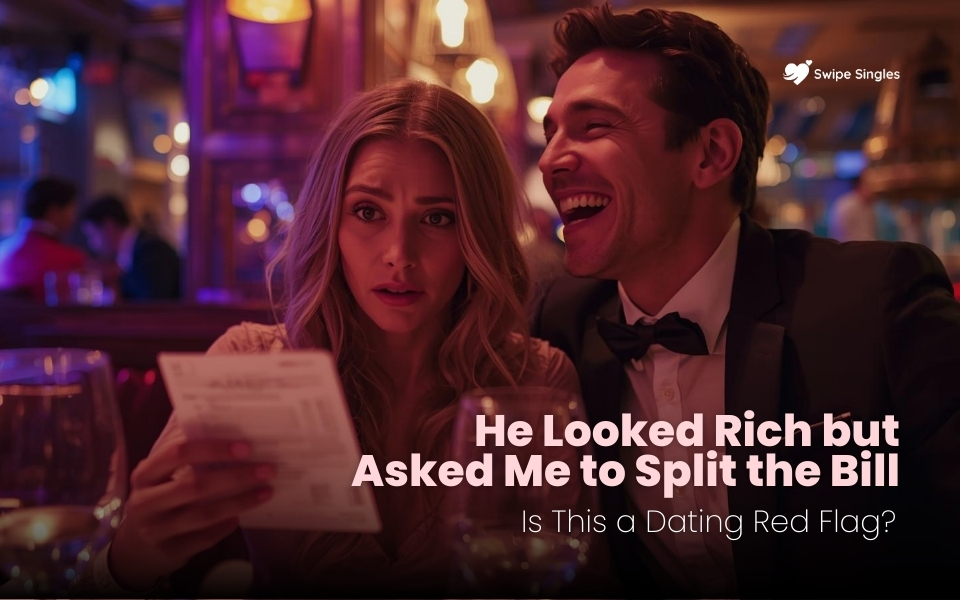
He looked like money.
Tailored jacket. Clean shoes. The kind of confidence that usually comes with knowing your card will not decline.
The conversation was easy. The food was great. Everything felt like it was going exactly how a first date should go.
Then the bill arrived.
He looked at it, smiled, and said, “What if we go halves on it?”
That single statement has the power to turn a date around in mere seconds. For some people, it is nothing but a routine. For others, it is pure embarrassment. For many, it raises a bigger question: is this one of those' huge dating mistakes' that people talk about, or just the first date etiquette of today, mingling with the reality of the day?
The dating apps have redefined the expectations in a way that money talks are done in the earliest of times, and splitting the bill is a very controversial issue nowadays, and surprisingly so. Deeply splitting the bill has been viewed as a continuing debate that goes between a fair and progressive standpoint on one side and a lack of effort, interest, or courtesy on the other.
So what is the message when a person whose financial status is apparently well-off asks to share the cost on the first date? And what is more important, should it be a reason for you to reconsider their future?
Few dating topics light up the internet like money on a first date.
A short clip of someone talking about splitting the bill can rack up millions of views. Comment sections turn into battlefields. Some people defend it as fair. Others call it cheap. A few see it as emotional laziness dressed up as equality.
Why does this tiny moment carry so much weight?
Because paying for a date is rarely just about money. People read it as a signal.
It can suggest effort. Interest. Respect. Values. Even long-term intentions. When those signals feel unclear, people fill the gap with their own experiences and insecurities.
Story-based platforms have made this even louder. One awkward dinner becomes a viral post. Thousands of strangers project their own dating history onto it. Someone who was used financially sees danger. Someone who was taken advantage of sees fairness.
So when a guy who looks wealthy asks to split the bill, people are not judging the number on the receipt. They are judging what it might say about his character, his intentions, and the kind of partner he could be.
And that is why this question never stays small.
Splitting the bill is no longer a niche behavior. It has quietly become part of mainstream dating, especially in cities and app-driven dating scenes.

Recent relationship surveys and dating platform reports from 2025 show a clear shift. More people expect shared expenses early on, but expectations still vary sharply by age, gender, and dating goals.
Here is what current data trends look like going into 2026:
|
Dating & Money Trend (2025–2026) |
What surveys show |
|
People who prefer splitting the bill on first dates |
58–62% |
|
Women who still expect the man to pay on the first date |
38–42% |
|
Gen Z daters who see splitting as respectful |
64% |
|
Daters who say money behavior affects attraction |
71% |
|
Couples who argue about finances within the first 6 months |
41% |
|
Breakups linked partly to financial behavior |
29–33% |
The conclusion is quite straightforward: sharing the expenses has become a standard practice, but it still carries a message.
Many people attach meaning to this act, whether they are aware of it or not. For some, it is a sign of fairness and emotional growth, while for others, it has a minor effect of diminishing attraction or increasing suspicions about the partner's generosity and effort.
Therefore, the proposal to equally split the bill leads to an emotionally charged situation where the respective culture, individual past, and contemporary dating scenario play a significant role in determining the degree of such an emotional charge.
Hence, it is very rare for people's responses to it to be rational. They are rather primal reactions.
Short answer: not automatically.
Splitting the bill by itself is not one of those clear dating red flags like lying, disappearing for days, or being rude to staff. It is neutral behavior. What turns it into a problem is the way it happens.
Context does the heavy lifting here.
Some people split because they believe in fairness. Some do it to avoid pressure or expectations. Others do it because they are cautious with money. None of those are unhealthy on their own.
But the details matter more than the total on the receipt.
When splitting the bill is not a red flag
In these cases, splitting the bill is just a preference, not a warning sign.
When it can become a red flag
That is when the issue stops being about money and starts being about communication, entitlement, and emotional awareness.
So the real question is not “Did he split the bill?”
It is “How did he handle it?”
That answer tells you far more about whether this is someone worth seeing again than the number printed at the bottom of the receipt.
A lot of the frustration comes from one detail: he did not look like someone who needed to split the bill.
Nice clothes. Expensive phone. Confident posture. Maybe even a luxury car waiting outside.
Our brains turn those signals into a story. He is successful. He is comfortable. He can afford this.
So when he asks to split, it feels like a contradiction.
But lifestyle signals and money values are not the same thing.
Some people earn a lot and still hate spending on dates. Some care deeply about financial boundaries. Others grew up watching money cause problems and learned to be strict with it. And some simply believe that splitting is the fairest option, regardless of income.
On the flip side, plenty of people who look average are generous to a fault.
That is why judging generosity based on appearance almost always leads to confusion.
Common “wealth signals” that mislead people:
None of these guarantees emotional generosity, kindness, or romantic effort.
So when someone who looks wealthy asks to split the bill, it is not proof that something is wrong. It is proof that appearances are a terrible shortcut for understanding how someone actually relates to money and relationships.

Money problems in relationships usually come from patterns, not from one awkward moment with a waiter standing nearby.
What matters is how someone behaves around money over time.
Here are warning signs that carry far more weight than whether they paid for pasta on a first date:
|
Financial red flag |
Why it matters in a relationship |
|
Avoids talking about money at all |
Suggests secrecy or fear of accountability |
|
Constantly complains about being broke, but spends impulsively |
Shows poor self-control |
|
Has significant debt with no plan |
Creates long-term stress |
|
Borrows money early in dating |
Blurs boundaries too fast |
|
Lies or exaggerates about income |
Damages trust |
|
Tries to control how you spend |
Leads to a power imbalance |
|
Gets angry over small expenses |
Signals emotional immaturity |
Someone can happily pay for dinner and still be financially reckless, dishonest, or controlling.
And someone can split the bill and still be responsible, transparent, and generous in ways that actually matter.
So if you are trying to protect your future self, watch how they handle money conversations, stress, and responsibility over time.
Dinner is easy.
Character is what shows up later.

Even when people support splitting the bill in theory, many still feel a quiet drop in attraction when it happens.
That reaction is not shallow. It is psychological.
First dates are full of unspoken signals. Who plans. Who follows up? Who pays attention? Who pays.
Our brains use these moments to answer one basic question: Is this person invested in me?
Paying for a date has long been associated with effort. Not because of the money itself, but because it shows willingness to give something up, even something small, for someone new.
When the bill is split without warning, some people subconsciously read it as:
There is also the safety factor. Many people, especially women, associate generosity with emotional security. Not luxury. Just the feeling of being considered.
Timing matters too.
If splitting is discussed beforehand, it feels neutral.
If it appears at the end, it can feel like a sudden emotional downgrade.
So the discomfort is rarely about being cheap or traditional.
It is about what the moment seems to communicate.
Interest or indifference.
Warmth or caution.
Connection or accounting.
That interpretation may not always be fair, but it is very human.
How Cultural Norms Shape Expectations Around Splitting the Bill
Every dating scene has its own unique financial script.
In some places, it is common practice to share the expense. In others, it is considered a sign of a lack of interest but is mostly avoided. None of the sides is wrong. They simply practice different social codes.
In many European countries, such as Germany, the Netherlands, etc., splitting the bill is considered a normal and even a common practice on the first date. It is an indication of independence, not disinterest.
In the US, the rules are not straightforward. People who date through apps, mainly in cities, pay their own way. Traditional dating still favors the person who pays the bill.
In certain regions of Asia and the Middle East, the one who pays is usually the one who shows respect and clarity of intention. Sharing the bill can be perceived as a sign of being emotionally distant or not being serious.
Even within the same country, context matters:
What feels rude in one setting can feel perfectly polite in another.
That is why one person sees splitting the bill as modern first date etiquette, while another quietly adds it to their list of dating red flags.
Both are reacting to the rules they learned.
Instead of replaying the moment in your head, zoom out.
One awkward bill does not define a person. Patterns do.
Ask yourself a few honest questions.
If most of your answers feel positive, this was probably just a difference in dating style. If they lean negative, your discomfort makes sense.
Attraction does not need a courtroom-level explanation. Sometimes your body notices what your logic tries to dismiss.
The bill might be small. The signal behind it is not.
You do not have to freeze, smile awkwardly, or agree to something that feels off.
You can be calm, clear, and still kind.
A few simple lines can set boundaries without turning the moment into a debate.
If you want to be direct:
If you want to keep it light:
If you want to protect your boundaries:
You are not being difficult. You are communicating.
And how someone responds to that tells you far more than whether they reached for the bill.
Splitting the bill is not automatically one of those dating red flags you should run from.
It is a preference.
But preferences still reveal things.
They reveal how someone communicates. How they handle awkward moments. How aware they are of another person’s comfort. How generous or guarded they are emotionally, not just financially.
A man can pay for every dinner and still be careless with your feelings.
On the other hand, one can split the bill and still show up with consistency, honesty, and real effort.
So do not judge the gesture alone.
Judge the pattern.
Judge the tone.
Judge how you felt walking away from the table.
That feeling is data.
And it is usually more accurate than any dating rule you will find online.

If you are done guessing what someone means, how they feel, or where they stand, it might be time for a different kind of dating space.
Swipe Singles is built for people who value clarity, effort, and emotional maturity. No games. No weird power plays. No reading between the lines after every date.
Meet people who say what they want and mean what they say.
Join Swipe Singles and date without the confusion.

A secure online dating platform for real singles seeking genuine connections, meaningful relationships, and safe dating experiences worldwide.