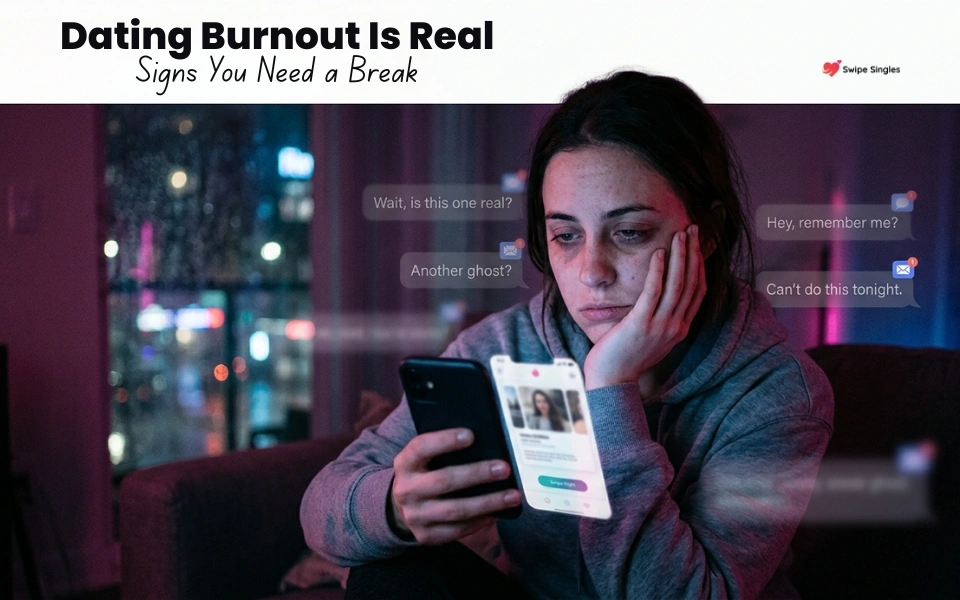
You can’t always tell which relationship will burn you out.
It often begins with something that feels right, easy conversations, shared expectations, and a sense of emotional safety that makes you want to invest fully. In today’s dating culture, where genuine connections feel rare, many people don’t hold back when they find something promising.
They show up consistently. They communicate clearly. They give their time, attention, and emotional energy without hesitation. And that’s exactly how it slowly turns.
The effort stays, but the clarity doesn’t. Conversations become unpredictable, and plans feel uncertain. What once felt mutual starts to feel one sided, but instead of stepping back, they try to hold it together a little longer.
Because it didn’t start this way, this pattern isn’t unusual anymore. Strong beginnings that lose direction, connections that stay undefined, and people giving more than they’re receiving, hoping things will settle, but rarely seeing that happen.
After a point, it’s no longer about one experience; it’s the build-up. You still want a real connection, but the process starts to feel heavier than it should. That’s usually where dating burnout begins.
The question is, how do you know when it’s actually burnout and not just a phase? And when is it a sign that you need a break?
Let’s break that down, starting with what dating burnout really means today.
Dating burnout is when dating starts to feel like effort more than interest. Opening an app, replying to a message, or starting a new conversation feels heavier than it should.
Being tired of dating can come and go. You feel it, take a short break, and things feel normal again.
Dating burnout feels different. It stays. Even when something seems promising, the energy to show up fully just isn’t there.
A big part of this comes from how dating works today.
It often feels like the same loop:
Again and again.
There’s also the uncertainty. Things can feel strong one day and unclear the next. That back-and-forth takes more out of you than you realize.
And with so many options around, effort doesn’t always stay consistent. People move on quickly, conversations fade, and intentions aren’t always clear from the start.
None of this feels like a big deal on its own. But when it keeps happening, it adds up. That’s when dating stops feeling exciting and starts feeling like dating fatigue, or what many now call dating exhaustion.
When dating starts to feel repetitive and draining, the right space can make all the difference. Swipe Singles is designed to help you navigate connections more clearly while feeling secure and in control, so dating feels lighter.
It usually doesn’t happen all at once.
You’re still showing up and still replying. Still open to meeting someone new. But the way it feels starts to change.
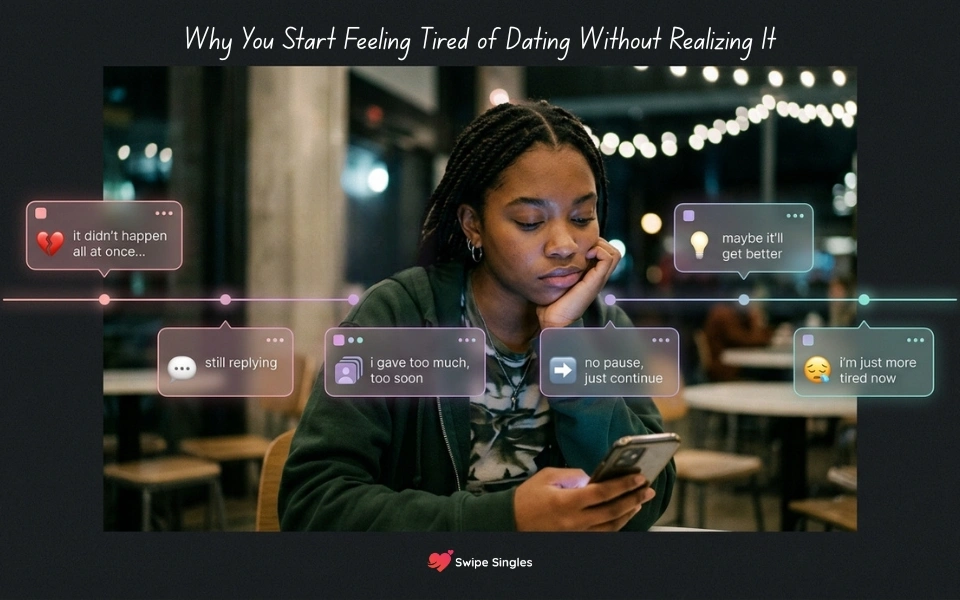
A big reason for that is how small patterns begin to build over time:
When something feels right, you give it your time and energy without holding back. When it doesn’t work out, you don’t always pause; you just start again.
There’s barely any time to process what just happened before you’re back to meeting someone new.
Hoping things will improve, waiting for clarity, or giving more chances than needed.
Trying to understand, trying to fix, trying to make it work, even when it feels off.
None of these feel like a big deal on their own.
But together, they slowly drain your energy.
And because it builds gradually, it doesn’t immediately feel like dating burnout. It just feels like you’re more tired than usual, less patient, and less interested than before.
That’s how dating fatigue sets in, quietly, until even the idea of dating starts to feel exhausting.
Dating burnout doesn’t always show up in obvious ways. It’s usually in small shifts, how you respond, how you feel, and how much energy you have left to give.
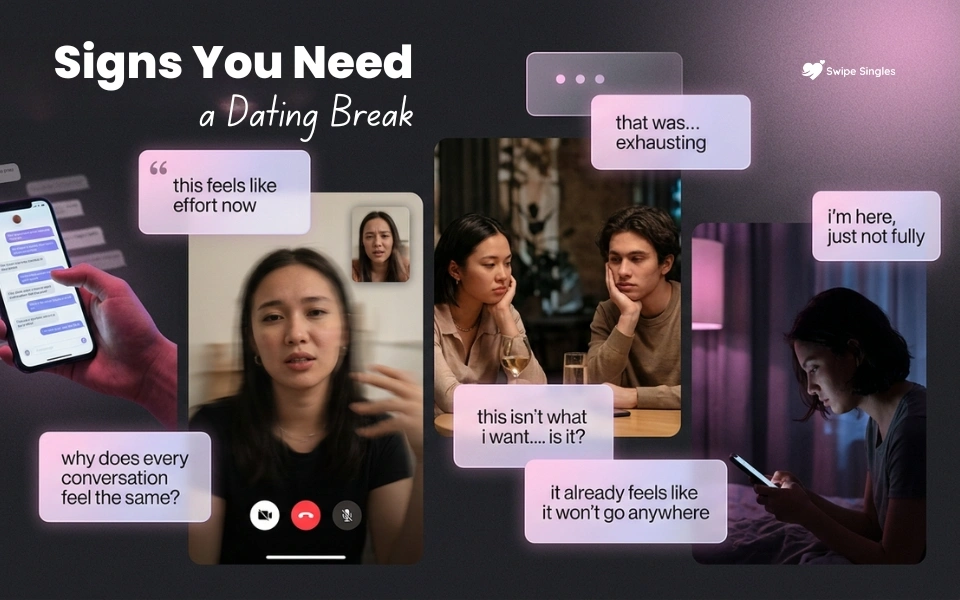
If a few of these feel familiar, it might be a sign you need a break:
Replying starts to feel like a task instead of something you want to do. You find yourself delaying responses, not because you’re busy, but because you just don’t feel like engaging. And every new conversation feels the same, the same questions, same introductions, same flow.
Instead of feeling excited after talking to someone, you feel mentally tired. Even when a date goes fine, it doesn’t leave you feeling good; it just feels like it took energy to get through.
There’s less excitement, less curiosity. You’re still going through the motions, replying and showing up, but without the same interest or emotional involvement as before.
You start entertaining things you normally wouldn’t. Ignoring small red flags, overlooking what doesn’t feel right, just to avoid starting over again or feeling nothing at all.
Before a conversation even starts, there’s already a sense of doubt. You expect it to go nowhere, lose interest quickly, or end the same way others did.
None of these signs means something is wrong with you. They usually just mean you’ve been giving more energy than you’ve had time to recover—and it might be time to take a step back.
When you’re already feeling low on energy, continuing to date the same way doesn’t always help; it usually makes things feel heavier.
You might start saying yes to things you’re not fully sure about. Not because you’re excited, but because starting over feels like too much.
You may stay in conversations or situations longer than you normally would, even when something feels off. Walking away takes more effort than just going along with it.
At the same time, your patience drops. Small things feel more frustrating, and dating stops feeling enjoyable.
And because there’s no real pause, all of this carries forward. So even when you meet someone new, it’s harder to feel fresh or open, you’re already a little drained.
Over time, this starts to affect the kind of connections you build. You’re not showing up with the same clarity or energy, which makes it harder to recognize what actually feels right.
That’s when dating stops feeling intentional and starts feeling like something you’re just getting through.
This is how dating burnout builds, not from one experience, but from continuing without giving yourself the space to reset.
Taking a break from dating can feel like stepping back from something you actually want.
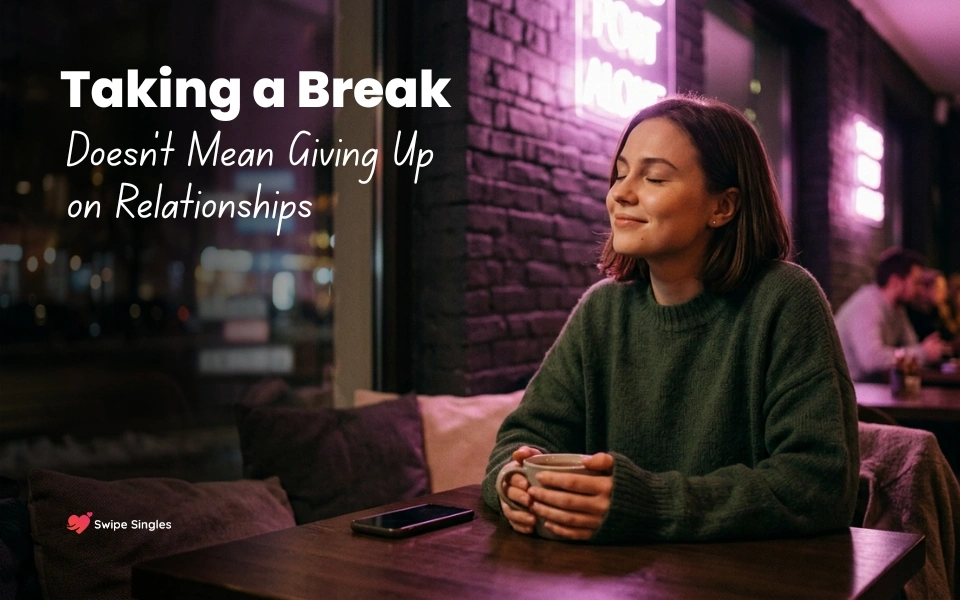
But in most cases, it’s not about giving up, it’s about giving yourself a pause.
When dating starts to feel heavy, pushing through it doesn’t make it better, it just makes everything feel forced.
Taking a break gives you space to step out of that cycle. It helps you reset how you feel about dating, instead of carrying the same frustration into every new interaction.
Without constant conversations, expectations, or trying to figure someone out, things start to feel quieter.
You’re not overthinking messages. You’re not trying to read between the lines. You’re just… not in that loop for a while.
And that space helps you reconnect with what you actually want, without outside noise.
A break doesn’t take you further away from relationships—it usually brings you back with a clearer mindset.
You have more energy, more patience, and a better sense of what feels right and what doesn’t.
So when you do start again, it feels more intentional, not something you’re just pushing through.
If dating has started to feel like something you have to do instead of something you enjoy, that’s usually a sign to pause.
Don’t quit. Don't give up, just pause.
Because the goal isn’t to fix everything, it’s to get out of the cycle long enough to feel normal again.
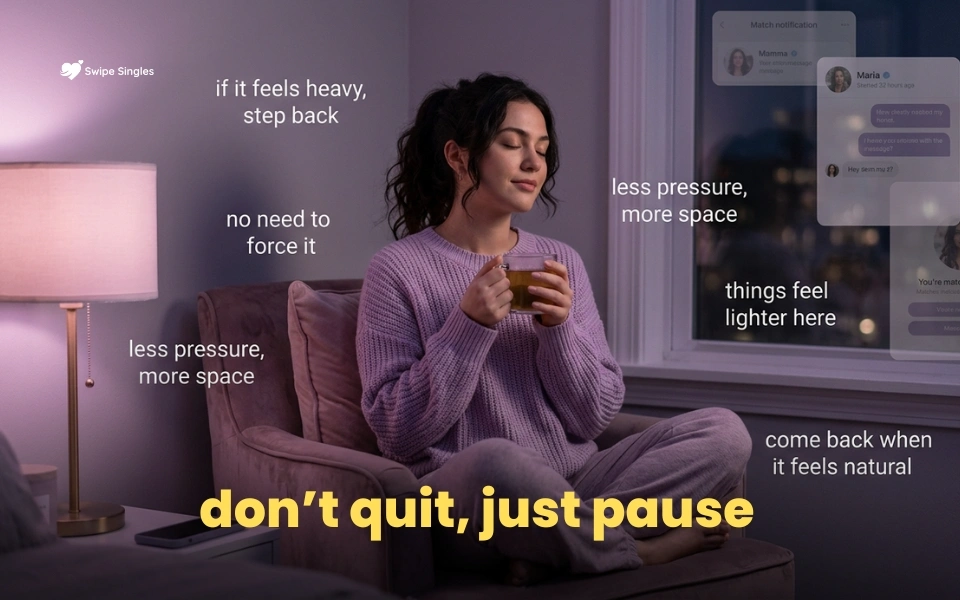
If dating feels heavy, that’s already your answer.
You don’t need to wait for things to get worse or push through just because you’ve already invested time. Not enjoying the process is reason enough to step back.
You don’t have to disappear completely, just create some distance.
That could mean:
Even small breaks from the cycle can make a difference.
It’s easy to start overthinking what went wrong, what you could’ve done differently, and what to do next.
You don’t need all those answers right now.
A break works better when it’s simple. Less analyzing, more just stepping away.
When you’re not constantly checking your phone or thinking about conversations, things start to settle.
You might notice:
That shift is the whole point.
There’s no timeline for when to start again.
You’ll usually know, you feel a bit more curious, a bit more open, and not as drained by the idea of meeting someone new.
That’s when dating feels like a choice again, not something you have to push yourself into.
Perfect, let’s close this in a way that feels calm, clear, and not salesy.
Dating shouldn't be a complex and tiring chore.
It's supposed to be intuitive. Light. Something you can enjoy being a part of.
If it doesn’t feel that way, that doesn't mean you're "broken." It probably just means you've been putting in more effort than you've been able to recover.
It might mean slowing down or changing your mindset when it comes to dating.
Because the right kind of spark doesn't come from forcing a process - it comes from putting yourself in the right place.
Sometimes this happens when you're in a place that is more manageable, more deliberate, and less chaotic.
That’s the idea behind Swipe Singles. A space designed to make dating feel clearer, calmer, and a little less like something you have to figure out on your own.
You don’t have to rush back into dating. But when you do, it should feel better than it did before.
Feel safe. Connect confidently.
Download Swipe Singles and meet someone real.
Common signs of dating burnout include feeling mentally tired after conversations, losing interest in meeting new people, and finding dating apps or messages feel like a chore rather than something you enjoy. You may also notice you’re less patient, more easily frustrated, or just going through the motions without real interest.
Feeling tired of dating is usually temporary; you take a short break and feel open to trying again. Dating burnout, on the other hand, lasts longer. Even when something seems promising, you don’t feel the same energy or excitement to engage. It feels more like emotional exhaustion than a passing phase.
Yes, dating fatigue is very common today. Repetitive conversations, unclear intentions, and inconsistent effort can make the process feel draining over time. It’s not a personal issue; it’s often a result of how modern dating works.
There’s no fixed timeline. A break should last until dating feels light and natural again, not forced. For some people, that could be a few weeks; for others, longer. The key is how you feel, not how much time has passed.
Yes, taking a break can help you come back with more clarity and energy. When you’re not feeling drained, you’re more likely to make better decisions, recognize what works for you, and build healthier connections. It’s less about “pausing progress” and more about resetting how you approach dating.

A secure online dating platform for real singles seeking genuine connections, meaningful relationships, and safe dating experiences worldwide.