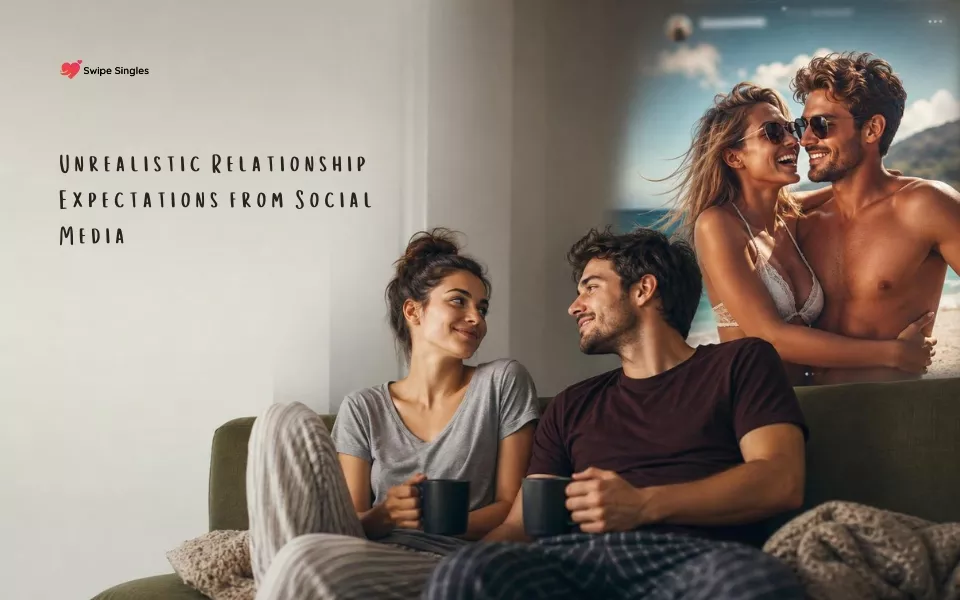
Social media has quietly rewritten the rules for love. It shapes how we judge beauty, success, and what a "good" modern relationship looks like. Most of that comes from content that was never meant to show the full picture. The problem isn't that people share their best moments. The problem is we treat those moments like the whole story.
As of mid-2026, the average person scrolls about two hours and 40 minutes a day. Most of that time goes to polished clips of someone else's best moments. Watch enough clips, and they start to feel normal. That's where unrealistic relationship expectations begin. They live in the gap between what's curated and what's actually average.
This post breaks down why that gap exists. We'll cover modern dating culture, everyday relationships, mental health, and how to stay grounded without quitting social media.
Social media rewards the moment that looks perfect. Filters, body editing tools, and algorithms all push the same kind of content. It's extreme. It's polished. People see these images every day. Over time, they start to feel normal, even though almost nobody lives that way full time.
Lifestyle content works the same way. Beaches, luxury buys, dream homes, and big wins rise to the top because they get clicks. The algorithm then shows you more of what you already pause on. This builds a loop. People share their best angles because that's what works. Viewers absorb those angles as normal. Expectations creep up.
Scrolling has become a quiet contest. Most people don't notice they're competing. The more curated a feed is, the harder it gets to measure your real life against someone else's highlight reel. This habit sits at the center of unrealistic relationship expectations. It shows up most in lifestyle, success, beauty, and self-worth.
Platforms favor content that looks impressive. Perfect routines, travel clips, big purchases, and major wins show up far more than the slow, average middle of life. That's where most of us actually live. Aspirational content also draws sponsorships, so creators keep making more of it. The average user watches a steady stream of other people's wins.
Watching that stream daily makes it easy to feel behind, even when nothing is wrong. Routine days start to feel dull. Over time, this builds false ideas about how fast success should come and how much a person should achieve by a certain age. Those ideas don't come from real data. They come from a feed built to show outliers.
Filters and AI tools don't just smooth skin anymore. They reshape faces and fix lighting. They create a kind of beauty that doesn't exist in real life. By 2026, these edits will be subtle and common. Many users forget they're even looking at altered images.
That sets a hard standard. People compare themselves to faces that were never natural to begin with. Nobody can win that comparison. Teens and young adults feel this most.
A 2026 report found that 45% of teens say they see "flawless" bodies on social media every day, and 43% of teen girls now use a filter on every photo they post. When the visible standard is fake, real skin and normal aging start to feel like flaws. They're not. They're just normal.
Social media doesn't just shape how people see themselves. It shapes what they expect from others. Polished couple photos build a version of love that looks effortless. Real relationships move more slowly and look messier. When real life doesn't match the online version, frustration builds fast. Normal friction starts to feel like proof that something is broken.
Couple content online shows nonstop affection and big gestures. It skips the quiet, unglamorous parts that make up most of a relationship, like disagreements and ongoing compromise. Watching only the highlights creates pressure to measure your relationship against a movie, not a real person.
This can look like expecting constant excitement instead of steady connection. It can mean comparing your partner to what you see online, or feeling insecure that your relationship isn't "Instagram-worthy." FOMO in love makes this worse. People worry their relationship is missing something just because someone else looks happier on a screen.
If this sounds familiar, it helps to revisit basic relationship advice on healthy pacing. Real intimacy rarely follows a highlight-reel timeline. It also helps to learn real relationship red flags. That way, you won't mistake normal imperfection for a warning sign, or miss a real one.
Friend groups feel this pressure too. Scrolling past a trip you weren't part of can leave you feeling left out. That moment was likely small and ordinary for the people in it. Over time, this can lead to quiet resentment, posting more just to stay visible, or reading likes as proof of how much someone cares. None of that reflects real friendship. It's just the part you can see.
Many people feel more "present" online than at home. Notifications and the urge to document everything crowd out real shared time. The focus shifts from the moment to capturing it. This can create distance at home, parents comparing their family to others online and teens feeling pressure to show an ideal home life. These patterns change how families talk and solve problems over time. When appearance becomes the priority, real closeness usually loses.
Modern dating runs on apps now. That shift changed expectations as much as it changed how people meet. The swipe format creates a constant sense that someone better is a few taps away. Even a good match can start to feel replaceable.
Profiles add to this illusion. Most people lead with their best photos. That's not dishonest, just curated. But when every profile looks confident, real interactions can feel disappointing by comparison. Real people come with quirks and chemistry that builds slowly. None of that shows up in a bio. This mindset shows up as less patience with normal flaws and a belief that compatibility should feel instant. It treats connection like something to consume, not build.
A 2026 survey found that 78% of Gen Z daters report real burnout from dating apps, and only 27% feel apps actually work for long-term love. Many blamed constant comparison and the pressure to look a certain way online. The issue was never that options exist. It's that the illusion of perfect options sets a bar real relationships can't clear.
That burnout isn't really about the apps themselves. It's about what the format trains you to do: judge people in half a second, keep one eye on the next profile, and treat a real conversation like it's competing with an infinite queue of better options. Swipe Singles was built around a different idea.
Instead of optimizing for endless choice, it's designed for people who want to actually slow down and get to know someone. Profiles lean toward real context over highlight-reel photos, and the platform's moderation and privacy controls exist so people feel safe enough to show up as themselves instead of performing for a stranger's swipe.
It won't fix what social media has done to everyone's expectations, but it removes one layer of the problem: a format that quietly tells you someone better is always one tap away.
This is also where casual dating vs serious relationship mindsets matter. A lot of dating fatigue comes from people being unsure what they actually want.
FOMO isn't just about travel anymore. It shows up in relationships too. Scroll through anniversary trips and matching photos, and you might wonder if your own relationship is falling short. This happens even when everything offline is fine.
Recent data backs this up. Pew Research found that 48% of adults under 30 see social media as an important way to show their partner they care, and 34% of partnered adults admit to checking a partner's phone without permission. That insecurity fuels overthinking and a focus on performance instead of enjoyment. FOMO pulls attention away from what's real. It creates distance, not closeness.
This pressure rarely announces itself. It builds slowly and shows up in your mood first.
Watch for a few signs:
If several of these sound familiar, your expectations are likely shaped more by feeds than by reality. Worth talking through honestly, either with yourself or your partner.
These comparisons rarely feel conscious. They build because the same curated patterns repeat across every feed. Putting the illusion next to the truth makes the gap easier to see.
|
Social Media Illusion |
What's Actually True |
|
Perfect relationships |
Every couple works through conflict and dull stretches |
|
Effortless success |
Most wins follow months or years of unseen effort |
|
Flawless beauty |
Filters and angles erase natural features |
|
Constant happiness |
People post highlights, not the lows |
|
Endless options in dating |
Real compatibility is rare and takes patience |
Once the gap is laid out, the pressure eases. It gets easier to catch the moment your expectations are shaped by something that was never real.
Unrealistic expectations don't stay on a phone screen. Constant comparison shapes how someone feels day to day. That includes their body, their relationships, and their own progress in life. Casual scrolling can slowly become a habit that erodes self-esteem.
Common effects include anxiety, low self-esteem, and depression linked to chronic comparison. Other effects include poor body image, trust issues, and emotional burnout. A 2026 report found that teens who spend more than three hours a day on social media face twice the risk of anxiety and depression compared to lighter users. Teens and young adults were hit hardest, especially when exposed to edited bodies and highlight-reel relationships.
This pressure rarely shows up as one big breaking point. More often, it builds as a quiet, background dissatisfaction. It shapes decisions until someone notices and steps back on purpose.
Algorithms don't just show you what you like. They amplify it. Every time you pause on a polished photo, the system feeds you more of the same. Your feed soon narrows into a tight loop of curated extremes. Those extremes start to feel like the norm, even though they're the outliers.

This cycle forms your impressions without much input from you. Posts that spark strong reactions get pushed to the top. That means the content you see most is also the least typical of average life. Engagement is the only signal the algorithm tracks. It has no idea how rare that moment was for the person who posted it.
A 2026 study on social comparison anxiety named repeated algorithm exposure as a major driver of the problem. It found that the swipe-and-scroll format reinforces standards real life can't match. Left unchecked, a feed becomes an echo chamber of perfection. Once you understand the system, it's easier to reshape what you follow on purpose.
Fixing this doesn't mean quitting social media. It means using it with more intention. Draw a clear line between what you see online and what you actually want.
A few habits help right away. Curate your feed around creators who show real, unedited moments. Limit time on accounts that trigger comparison. Track your screen time so scrolling stops feeling automatic. Notice your mood before and after scrolling. Build hobbies that exist entirely offline. Pause before posting to ask if you're sharing for connection or for validation.
For relationships, talk openly with your partner about expectations shaped by social media. Setting clear, honest relationship boundaries around what gets posted versus simply lived can help a lot. Stop measuring your relationship against couples you barely know.
Focus on experiences over aesthetics. Keep some meaningful moments private, just because they're yours. Practicing real presence, putting the phone down, is one of the simplest ways to rebuild the emotional connection that comparison culture chips away at.
It also helps to name manipulation tactics that hide behind a polished online persona. Learning to spot love bombing and recognizing gaslighting protects you from mistaking intensity for real connection. That's an easy mix-up when social media trains you to treat "dramatic" as "real."
Small, steady habits do more than one big reset. Each habit below targets a different part of the comparison cycle. Pick the ones that fit your life.
|
Habit |
Why It Helps |
|
Phone-free hours |
Creates space for real connection and reduces mindless scrolling |
|
Curated the following list |
Keeps your feed from becoming a comparison minefield |
|
Intentional posting |
Removes the pressure to perform or prove anything |
|
Offline hobbies |
Builds self-worth that isn't tied to likes or views |
|
Digital detox weekends |
Resets your emotional baseline and improves focus |
None of these are strict rules. They're small, adjustable habits. Used regularly, they break the comparison cycle and bring your focus back to your own life.
Platforms keep changing, and so do the expectations tied to them. AI influencers, hyper-realistic filters, and immersive content keep blurring the line between real and staged. As these tools grow more advanced, the gap between online perfection and everyday life could keep growing, unless people learn to navigate it on purpose.
At the same time, there's a real push toward authenticity. More users are tired of overly polished feeds. Many now follow creators who show ordinary, unedited moments. Some platforms have started boosting unfiltered content and testing features that limit retouching.
Regulators and mental health groups are paying closer attention too. Talk of transparency labels for AI-edited images grew steadily through 2025 and into this year. That conversation keeps gaining ground in 2026. As it does, people are getting a clearer way to tell what's real from what's enhanced.
The future here isn't really about better technology. It's about learning to separate curated content from reality, so expectations stop becoming something no real relationship could ever meet.
Unrealistic expectations don't appear overnight. They build slowly, through small comparisons and polished posts, until online life starts to feel bigger than the real thing in front of you. Social media can inspire and connect people in good ways. It can also quietly distort what feels normal if you're not paying attention.

The goal was never to quit the internet completely. It's to understand how it works. Once you can tell curated perfection apart from ordinary reality, the pressure eases. You stop chasing someone else's version of love and start paying attention to your own.
A healthier relationship with social media doesn't take sweeping change. It takes small, intentional choices made over and over. With the right habits, you can enjoy these platforms without letting them quietly reset what you expect from your own life.
Real connection grows fastest when you step away from comparison and choose spaces built around people, not performance. That's the gap Swipe Singles was built to close. It offers a more intentional way to date, without the pressure of curated perfection driving every move.
Strong moderation, clear community guidelines, and real privacy controls are part of the platform by design, because real connection only works when people feel safe to be themselves. If social media has made dating feel exhausting, try a soft dating approach on Swipe Singles instead. It's built around real people and real pacing, not a highlight reel.
Social media shows curated highlights, not everyday reality. Filters and algorithms push idealized content. This makes it easy to mistake rare, polished moments for normal life.
Yes. Constant exposure to idealized couples can create doubt, even in strong relationships where nothing is wrong. The comparison itself becomes the problem.
Comparison triggers feelings of not being good enough. Measuring your real life against polished content often leads to frustration and emotional fatigue.
Yes, generally. Teens and young adults spend more time on image-heavy platforms. They face more exposure to filters and viral trends, which makes comparison harder to avoid.
TikTok pushes fast-moving relationship trends and viral "tests." Instagram leans toward polished couple photography. Both can fuel comparison, just in different styles.
Curate your feed, limit screen time, follow creators who post realistic content, and stay present offline. These steps help reset expectations without full disconnection.
A healthy comparison might mean learning from a couple's communication style. Harmful comparison culture means measuring your relationship against a curated highlight reel.

A secure online dating platform for real singles seeking genuine connections, meaningful relationships, and safe dating experiences worldwide.