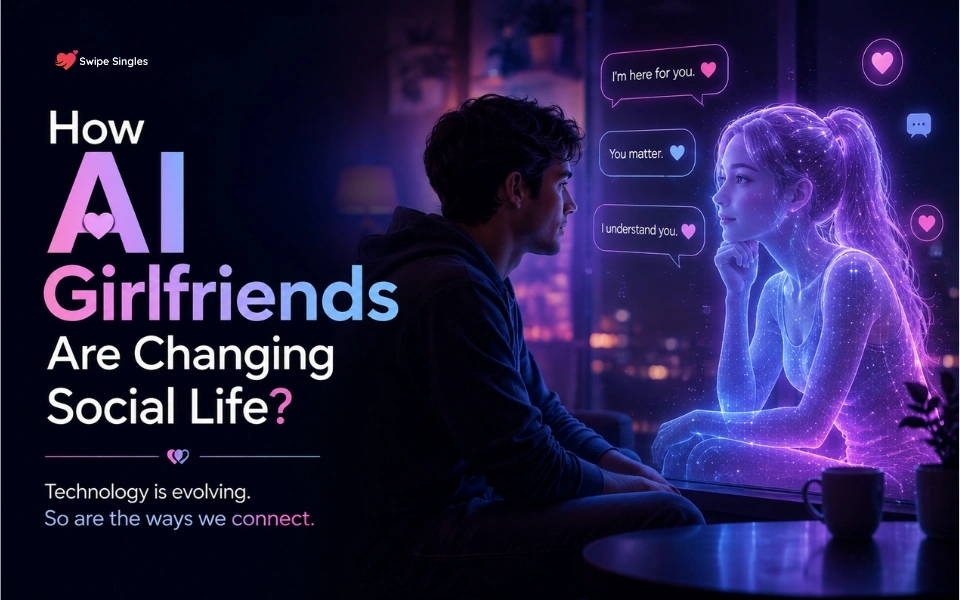
What if your closest conversation wasn't with another person but with AI? That question is becoming more relevant as millions of people turn to an AI girlfriend or AI companion for support, advice, or simply someone to talk to. What started as a niche technology is quickly becoming part of everyday life.
Researchers are now studying what this shift means for human connection and modern dating. Can AI relationships help people feel less alone, or could they change how we build real relationships? Drawing on studies from MIT Media Lab, Stanford University, and Common Sense Media and the Wheatley Institute, this article examines the impact of AI girlfriends on social life and what the latest evidence really shows.
AI companions are no longer a niche technology. An AI girlfriend is an AI-powered chatbot designed to simulate companionship through personalized conversations. People use these virtual companions for emotional support, casual chats, or relationship-like interactions.
Better AI models have made these conversations feel more natural and personal. Today, millions of people use an AI companion to chat, seek advice, or simply have someone to talk to.
The numbers show how quickly this trend is growing. A Wheatley Institute survey found that 19% of U.S. adults have chatted with an AI romantic companion, while nearly one in three men in their twenties have done the same. Common Sense Media also found that 74% of U.S. teens have used an AI companion.
Growing Adoption of AI Companions:
|
Metric |
Value |
|
U.S. adults who have used an AI romantic companion |
19% |
|
Men in their twenties |
~33% |
|
Character. AI monthly active users |
20 million |
|
Replika registered users |
40+ million |
Platform growth tells the same story. Character. AI currently has around 20 million monthly active users, while Replika has accumulated over 30 million registered users since its launch. AI companionship is becoming part of daily life, especially for younger generations like Gen Z.
The trend is clear. People are no longer asking what an AI girlfriend is. They're asking whether it can meet emotional needs that were once met only by real people. That question is driving the next stage of research.

There are various reasons for using AI relationships. Some want advice. Some want to discuss with someone after a bad day. Many just want to have someplace they can speak without being judged.
This has been seen in research, particularly among young users. One-third of U.S. teens preferred to speak with their AI companion rather than a person for serious conversation, according to a Common Sense Media survey. It also discovered that 25% of them had provided personal information to an AI.
The same study has another side to it. 80% of teens reported that they spend more time with their real friends than with an AI friend. That means the majority of people do not mean to replace human interactions with AI but rather to use it as a supplement.
This shift says as much about people as it does about technology. With the digitalization of life, many are seeking fast, private, and always-available communication. The next question is, do those conversations change the way people relate to one another?
It's not a question of how many people use AI companions. It's what they do after that. To learn, MIT Media Lab and OpenAI conducted one of the largest studies on the usage of chatbots. The study involved a four-week experiment testing nearly 1,000 users, as well as analyzing approximately 40 million conversations with ChatGPT.
There was a definite pattern in the results. Those who interacted with chatbots more often were also more likely to feel lonely, emotionally dependent on the chatbot, and spend less time with others. Among the heavy users, researchers also identified signs of problematic use.
However, there's something important to note. The study revealed a correlation but did not prove that it was cause and effect. Researchers were unable to determine if AI companions increased feelings of loneliness or if individuals who already felt lonely used AI more often.
This discovery has a major impact on the perception of AI relationships. It is not a complete solution, just the technology. Individuals' behaviors, psychology, and motivations for using AI can be just as significant to the results. Researchers say there are still more long-term studies to be done before any firm conclusions can be drawn.

No, AI cannot fully match a real relationship. An AI girlfriend can remember past conversations, offer support, and reply in seconds, making the experience feel personal. However, AI does not have genuine emotions, personal memories, or real-life experiences. It responds based on patterns and programmed interactions rather than feelings, which creates an important difference between AI companionship and a real relationship.
That's the biggest difference between an AI girlfriend and a real relationship. AI can offer comfort during difficult moments. A real partner brings trust, shared experiences, and emotional growth. Those qualities develop over time and cannot be generated by software.
So, can AI girlfriends replace real partners? Current research suggests they serve a different purpose. They may help people practice communication, reflect on their feelings, or cope with loneliness. But lasting healthy relationships still depend on real people, shared experiences, and mutual effort.
One message stands out. AI is changing how people seek support, not redefining what love or friendship means. As the technology improves, the challenge will be using it to strengthen real-life connections rather than replace them.
AI companions are not only studied for the risks but also for their benefits. Scientists are also investigating how they can aid in the development of confidence and communication skills.
Stanford University is an example of this. AI chatbots are being tested to help autistic teens and adults practice their social skills for real-life interactions. The chatbot can be used to practice asking questions, making mistakes, and gaining confidence in a safe environment, free from social pressure.
This demonstrates that AI has a value that is dependent on its use. It can be a communication asset, not a replacement for relationships, when it helps to facilitate real-world interactions.
AI companions are becoming more personal. People share their thoughts, feelings, and relationship struggles with these chatbots. That also means they trust companies with deeply personal data.
That trust has already been tested. A Cybernews investigation found that a security flaw exposed more than 400,000 user records from an AI companion platform. The leaked data included private messages and uploaded images, raising fresh concerns about privacy and data protection.
The issue goes beyond one security breach. As AI companions become part of daily life, users will expect companies to protect their conversations just as carefully as they protect their personal data. Trust may become one of the biggest factors shaping the future of AI relationships.

AI companions are already changing how some people communicate and seek support. For some, they offer a safe place to practice conversations or think through personal challenges before speaking with a partner. That could influence modern dating, especially for people who struggle with confidence or social anxiety.
At the same time, experts say AI should support, not replace, real relationships. Healthy relationships grow through trust, honest conversations, and shared experiences. Those are things people build together over time, not something technology can recreate.
The bigger change may be in expectations. As AI becomes part of everyday life, people may expect faster replies, more emotional availability, or constant support. Learning to balance digital companionship with real-life relationships could become one of the biggest dating trends in the years ahead.
The AI girlfriends' impact on social life is still evolving. Millions of people are already using AI companions, and research shows they can offer support, comfort, and a place to talk. At the same time, studies raise important questions about loneliness, privacy, and how AI may affect real-life relationships.
So, can AI girlfriends replace real partners? The evidence so far suggests they serve a different role. AI may help people through difficult moments or improve communication, but lasting relationships still depend on trust, shared experiences, and genuine human connection. As AI becomes part of everyday life, its success may depend less on how smart it becomes and more on how wisely people choose to use it. If you're looking to build genuine relationships beyond the screen, SwipeSingles offers a place to meet real people and create meaningful connections.
Ready to turn meaningful conversations into real connections? Download SwipeSingles today.

A secure online dating platform for real singles seeking genuine connections, meaningful relationships, and safe dating experiences worldwide.