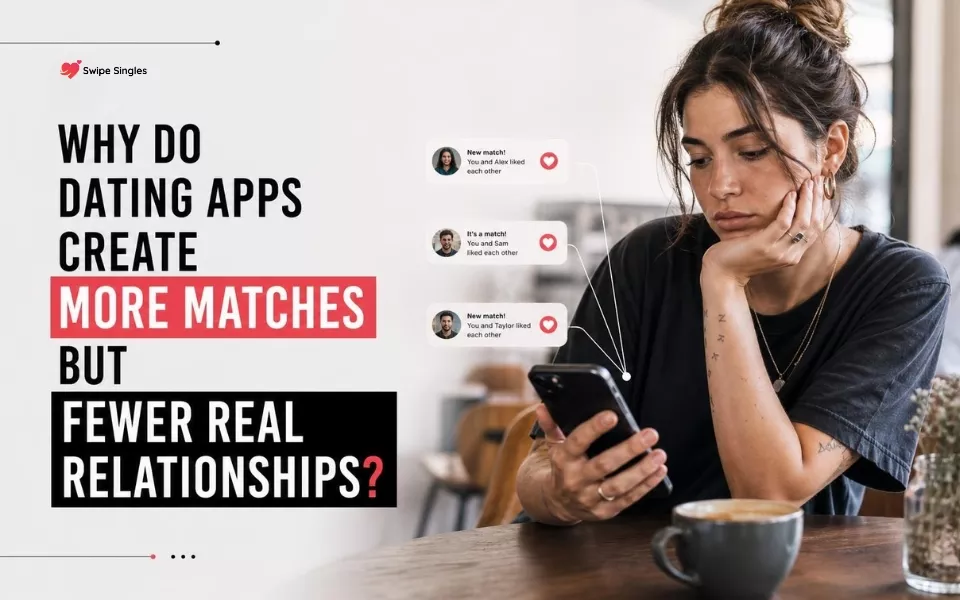
Finding a match has become easy. But finding someone who truly stays is the hard part. That's the challenge many singles face today. Dating apps have changed how people look for love, making online dating a normal part of modern relationships. Yet despite all those opportunities, many users still struggle to build relationships that last.
So why do so many people still feel stuck?
The answer isn't that people have stopped wanting love. Most are still looking for someone who shares their values and relationship goals. The challenge is that today's dating experience often rewards speed over connection, making it harder to build something real.
In this blog, we'll explore why people swipe more but connect less, what causes dating burnout, and how a few simple changes can help you build stronger, more genuine relationships online.
More than 350 million people around the world use dating apps to meet new people. Every day, millions of matches are made, making online dating one of the most popular ways to look for a relationship.

Yet the results tell a different story. Dating apps now reach hundreds of millions of users, but matching and meeting are still very different things. Even when people swipe and chat, many connections never turn into a real date.
This is the reason why people swipe more but connect less. Swiping feels like progress because every match offers new possibilities. But a match is only the starting point. Without meaningful conversations and real effort, most connections never move beyond the app.
It is one of the most prominent dating issues of today. There are more opportunities for people to meet than ever before, but many aren't able to make connections that endure in the long-term. Rather than develop one possible match, it can be simple to keep seeking out the next one.
Online dating is not about obtaining matches. It should be finding one person to get to know. The concept behind Swipe Singles is to focus on compatibility and common interests instead of swiping so that users can spend less time looking at people and more time connecting with them.
Getting a match feels exciting, but it’s only the first step. The real challenge is turning that match into a conversation, then a date, and eventually a relationship. At every stage, more people drop off.
Here’s what that journey usually looks like:
|
Stage |
What it means |
Share |
|
Swipe to match |
Right swipes that turn into a match |
~2–5% (men), ~40–44% (women) |
|
Match to conversation |
Matches that become a real back-and-forth |
~15% |
|
Match to date |
Matches that lead to an actual first date |
~14–20% |
The first hurdle is getting a match. SwipeStats found that men have an average match rate of 5.26%, while women average 44.4%. Even so, matching doesn’t guarantee that two people will actually talk.
The biggest drop comes after that. Around 30% of matches never exchange a single message. SwipeStats also found that 43% of matches never become real conversations. For men, only about 15% of matches turn into an active back-and-forth, and just 2% develop into deeper conversations.
Even when people enjoy chatting, many never meet in person. Studies suggest that only 14% to 20% of matches eventually become a first date. The rest slowly fade away or stop without an explanation.
A few common habits make online dating problems worse:
This helps explain why it is hard to connect on dating apps. Success isn’t about getting the most matches. It’s about giving one good conversation enough time and attention to grow.
That’s also the thinking behind Swipe Singles. Instead of pushing users to keep swiping, the platform encourages people to connect through shared interests and compatibility. When conversations start with more in common, they’re more likely to lead to a real date instead of ending after a few messages.
Many people join dating apps to feel more connected. So why do they often end up feeling the opposite? The answer isn’t a lack of matches. It’s how people experience online dating. Small habits and app design can make it harder to build real relationships, even when plenty of opportunities are available.

Here are three reasons why that happens:
Having lots of options sounds like a good thing. But research shows that too many choices can make people less satisfied and more unsure about their decisions.
Instead of focusing on one good match, many users keep wondering if someone better is just another swipe away. That can lead to emotional confusion and make it harder to invest in one person.
In real life, attraction grows through conversation, body language, and shared experiences. Dating apps work differently.
Most swipes happen in less than a second. That’s much faster than the few seconds our brains usually take to form a first impression in person. As a result, people often judge a profile before learning anything meaningful about the person behind it.
Dating apps are designed to keep people coming back. Every new match or message creates a small sense of excitement because you never know when it will happen.
Experts compare this to a slot machine. That unpredictable reward keeps people checking the app, even when they aren’t enjoying the experience anymore.
Research also points to a deeper concern. A 2020 study published in BMC Psychology found that daily users of swipe-based dating apps were almost four times more likely to report signs of depression than non-users. This doesn't mean the apps caused depression. It simply shows that heavy app use and poor dating experiences may affect a person's mental health. While this doesn’t prove that dating apps cause depression, it does show that heavy use and negative experiences can affect emotional well-being.
These patterns help explain why dating apps feel lonely. Many people spend more time searching for new matches than building trust with the ones they already have.
After looking at the challenges, one question remains: Do dating apps actually work? The answer is yes, but success depends on how people use them.

Dating apps have changed the way people meet. A landmark Stanford University study found that 39% of heterosexual couples who formed relationships in 2017 met online, up from 22% in 2009. Today, meeting through the internet is a normal part of modern dating.
Still, meeting someone is only the beginning.
Research by sociologist Michael Rosenfeld shows that online dating became the most common way heterosexual couples met by 2017. Dating apps are great at introducing people, but building a healthy relationship takes much more than a match.
A 2025 study across 50 countries found that couples who met online reported slightly lower relationship satisfaction than couples who met offline. The difference was small, but it highlights an important point. A successful relationship depends on trust, communication, and shared values, not where two people first met.
This also helps explain why people use dating apps but don't date. Many users spend weeks chatting without planning a real meeting. Others keep searching for new matches because they worry someone better might appear.
The bigger picture tells a similar story. The U.S. Surgeon General’s 2023 Advisory reported that about half of U.S. adults experience loneliness. It also warned that long-term loneliness can affect health as much as smoking 15 cigarettes a day. While dating apps help people meet, they can’t replace real human connection.
Another trend is worth watching. According to Sensor Tower, time spent on AI companion apps has more than doubled in 2026, while interest in traditional dating apps has declined. It suggests that many people are looking for deeper conversations and emotional support in different ways.
One simple change can improve your dating experience. Instead of trying to collect more matches, focus on building one good conversation at a time.
|
Swipe Habit |
Connection Habit |
|
Swiping for hours |
Swiping with purpose |
|
Sending “Hey” |
Writing a personal first message |
|
Talking to many matches |
Giving one or two conversations your attention |
|
Waiting weeks to meet |
Planning a date when the conversation feels right |
|
Counting matches |
Focusing on real conversations |
Many singles are now choosing a different approach, and platforms like Swipe Singles reflect that change. The focus isn't on spending more time swiping. It's on helping people slow down, connect with the right person, and turn good conversations into real relationships.
Finding a meaningful relationship doesn't always require a new dating app or hundreds of new matches. In many cases, it's about changing how you approach online dating. Small, thoughtful habits can lead to better conversations, stronger trust, and a much higher chance of building a lasting relationship.
If you're wondering how to build meaningful connections online, these practical tips can help.
Avoid swiping just to pass the time. Before you like someone's profile, take a few extra seconds to learn about them. Read their bio, look at their interests, and think about whether your values and relationship goals are a good match.
A few thoughtful matches are far more valuable than dozens of random ones. When you swipe with intention, every conversation starts with a stronger foundation.
A simple "Hey" rarely stands out. Instead, use something from the other person's profile to start the conversation. Ask about a hobby, a favorite travel destination, or something that caught your attention.
A personal message shows you've taken the time to learn about them. It also gives the other person an easy way to reply, making the conversation feel more natural from the beginning.
Talking to too many people at once can quickly become overwhelming. When your attention is divided, conversations often become short, delayed, or repetitive.
Instead, spend more time getting to know one or two people you genuinely connect with. Giving a conversation your full attention helps build trust and makes it easier to see whether there's real potential for a relationship.
Text messages are a great way to break the ice, but they shouldn't be the only way you get to know someone. If you've been enjoying your conversations for a while, consider suggesting a phone call, a video chat, or a casual coffee date when both of you feel comfortable.
Meeting sooner can help you understand whether the connection feels just as natural in real life as it does on the screen.
Many people judge their dating success by the number of matches they receive. In reality, one genuine connection is worth far more than dozens of conversations that never move forward.
Be patient and stay true to what you're looking for. Healthy relationships aren't built overnight. They grow through honest communication, shared values, and consistent effort. Sometimes, slowing down is the fastest way to find the right person.
That's also why many singles are exploring platforms like Swipe Singles. By bringing together people with similar relationship goals and encouraging more thoughtful interactions, the experience becomes less about collecting matches and more about creating relationships that have the potential to last.
The research throughout this article points to one clear conclusion. People haven’t stopped looking for love. They’re simply trying to find it in a dating world that moves faster than ever.
That's why“people swipe more but connect less”has become such an important question. While dating apps have made meeting new people easier, lasting relationships still depend on trust, honest communication, and shared values.
The best results don’t come from swiping more. They come from slowing down, being intentional, and giving the right person a real chance.
That same idea is at the heart of Swipe Singles. Instead of turning dating into an endless cycle of matches, the platform encourages people to connect through shared interests, long-term compatibility, and genuine conversations. When the focus shifts from collecting matches to building relationships, finding a meaningful connection becomes much more achievable.
Looking for more than just a match? Download Swipe Singles and start your journey today.
Many people spend more time collecting matches than building relationships. Too many choices, dating burnout, and low-effort conversations often stop matches from turning into real dates.
Many matches never become conversations. Others end before people meet because of poor communication, delayed replies, or a lack of shared intentions.
Yes. Millions of couples have met online. However, success depends on how people use the apps. Strong communication and shared values matter more than the number of matches.
Set a daily limit for swiping, focus on quality conversations, and take breaks when dating starts to feel stressful instead of enjoyable.
Yes. Taking a short break can reduce dating burnout and help you return with a fresh mindset. It also gives you time to reflect on your relationship goals, making it easier to focus on meaningful conversations instead of swiping out of habit.

A secure online dating platform for real singles seeking genuine connections, meaningful relationships, and safe dating experiences worldwide.